Showing posts with label Fathers (T). Show all posts

Tuesday, February 25, 2014

Being a Righteous Husband and Father (Howard W. Hunter, President of the Church, October 1994 General Conference)


Be faithful in your marriage covenants in thought, word, and deed.... One of the greatest things a father can do for his children is to love their mother.... A righteous father protects his children with his time and presence.... Together with your wife, you determine the spiritual climate of your home. Your first obligation is to get your own spiritual life in order.... Take seriously your responsibility to teach the gospel to your family through regular family home evening, family prayer, devotional and scripture-reading time, and other teaching moments.

My dear brethren of the priesthood, I consider it a privilege to meet with you this evening in this general priesthood meeting. The priesthood is the greatest brotherhood on the earth. I feel great strength in seeing your faithfulness and feeling your love and sustaining vote. We are particularly grateful to have so many of our Aaronic Priesthood brethren here with their fathers or advisers.

The subject of my address this evening will be more particularly directed to the husbands and fathers. All of you who hold the Aaronic Priesthood will soon arrive at the years of marriage and fatherhood. Therefore, what I say tonight has application to all present.

I wish to speak of the relationship that a man holding the priesthood should have with his wife and children. With a knowledge of the plan of salvation as a foundation, a man who holds the priesthood looks upon marriage as a sacred privilege and obligation. It is not good for man nor for woman to be alone. Man is not complete without woman. Neither can fill the measure of their creation without the other (see 1 Cor. 11:11; Moses 3:18). Marriage between a man and a woman is ordained of God (see D&C 49:15–17). Only through the new and everlasting covenant of marriage can they realize the fulness of eternal blessings (see D&C 131:1–4; D&C 132:15–19). As a matter of priesthood responsibility, a man, under normal circumstances, should not unduly postpone marriage. Brethren, the Lord has spoken plainly on this matter. It is your sacred and solemn responsibility to follow his counsel and the words of his prophets.

The prophets of the past have spoken also of those who may not have opportunity to marry in this life. President Lorenzo Snow said:

“There is no Latter-day Saint who dies after having lived a faithful life who will lose anything because of having failed to do certain things when opportunities were not furnished him or her. In other words, if a young man or a young woman has no opportunity of getting married, and they live faithful lives up to the time of their death, they will have all the blessings, exaltation, and glory that any man or woman will have who had this opportunity and improved it. That is sure and positive” (The Teachings of Lorenzo Snow, comp. Clyde J. Williams, Salt Lake City: Bookcraft, 1984, p. 138).

I believe President Snow’s statement to be true.

A man who holds the priesthood shows perfect moral fidelity to his wife and gives her no reason to doubt his faithfulness. A husband is to love his wife with all his heart and cleave unto her and none else (see D&C 42:22–26). President Spencer W. Kimball explained:

“The words none else eliminate everyone and everything. The spouse then becomes pre-eminent in the life of the husband or wife and neither social life nor occupational life nor political life nor any other interest nor person nor thing shall ever take precedence over the companion spouse” (The Miracle of Forgiveness, Salt Lake City: Bookcraft, 1969, p. 250).

The Lord forbids and his church condemns any and every intimate relationship outside of marriage. Infidelity on the part of a man breaks the heart of his wife and loses her confidence and the confidence of his children (see Jacob 2:35).

Be faithful in your marriage covenants in thought, word, and deed. Pornography, flirtations, and unwholesome fantasies erode one’s character and strike at the foundation of a happy marriage. Unity and trust within a marriage are thereby destroyed. One who does not control his thoughts and thus commits adultery in his heart, if he does not repent, shall not have the Spirit, but shall deny the faith and shall fear (see D&C 42:23; D&C 63:16).

A man who holds the priesthood has reverence for motherhood. Mothers are given a sacred privilege to “bear the souls of men; for herein is the work of [the] Father continued, that he may be glorified” (D&C 132:63).

The First Presidency has said: “Motherhood is near to divinity. It is the highest, holiest service to be assumed by mankind” (in James R. Clark, comp., Messages of the First Presidency, 6 vols., Salt Lake City: Bookcraft, 1965–75, 6:178). The priesthood cannot work out its destiny, nor can God’s purposes be fulfilled, without our helpmates. Mothers perform a labor the priesthood cannot do. For this gift of life, the priesthood should have love unbounded for the mothers of their children.

Honor your wife’s unique and divinely appointed role as a mother in Israel and her special capacity to bear and nurture children. We are under divine commandment to multiply and replenish the earth and to bring up our children and grandchildren in light and truth (see Moses 2:28; D&C 93:40). You share, as a loving partner, the care of the children. Help her to manage and keep up your home. Help teach, train, and discipline your children.

You should express regularly to your wife and children your reverence and respect for her. Indeed, one of the greatest things a father can do for his children is to love their mother.

A man who holds the priesthood regards the family as ordained of God. Your leadership of the family is your most important and sacred responsibility. The family is the most important unit in time and in eternity and, as such, transcends every other interest in life.

We reiterate what was stated by President David O. McKay: “No other success [in life] can compensate for failure in the home” (David O. McKay quoting J. E. McCulloch, “Home: the Savior of Civilization,” in Conference Report, Apr. 1935, p. 116) and President Harold B. Lee: “The most important of the Lord’s work you and I will ever do will be within the walls of our own homes” (Harold B. Lee, Stand Ye in Holy Places, Salt Lake City: Deseret Book Co., 1974, p. 255). Effective family leadership, brethren, requires both quantity and quality time. The teaching and governance of the family must not be left to your wife alone, to society, to school, or even the Church.

A man who holds the priesthood accepts his wife as a partner in the leadership of the home and family with full knowledge of and full participation in all decisions relating thereto. Of necessity there must be in the Church and in the home a presiding officer (see D&C 107:21). By divine appointment, the responsibility to preside in the home rests upon the priesthood holder (see Moses 4:22). The Lord intended that the wife be a helpmeet for man (meet means equal)—that is, a companion equal and necessary in full partnership. Presiding in righteousness necessitates a shared responsibility between husband and wife; together you act with knowledge and participation in all family matters. For a man to operate independent of or without regard to the feelings and counsel of his wife in governing the family is to exercise unrighteous dominion.

Keep yourselves above any domineering or unworthy behavior in the tender, intimate relationship between husband and wife. Because marriage is ordained of God, the intimate relationship between husbands and wives is good and honorable in the eyes of God. He has commanded that they be one flesh and that they multiply and replenish the earth (see Moses 2:28; Moses 3:24). You are to love your wife as Christ loved the Church and gave himself for it (see Eph. 5:25–31).

Tenderness and respect—never selfishness—must be the guiding principles in the intimate relationship between husband and wife. Each partner must be considerate and sensitive to the other’s needs and desires. Any domineering, indecent, or uncontrolled behavior in the intimate relationship between husband and wife is condemned by the Lord.

Any man who abuses or demeans his wife physically or spiritually is guilty of grievous sin and in need of sincere and serious repentance. Differences should be worked out in love and kindness and with a spirit of mutual reconciliation. A man should always speak to his wife lovingly and kindly, treating her with the utmost respect. Marriage is like a tender flower, brethren, and must be nourished constantly with expressions of love and affection.

You who hold the priesthood must not be abusive in your relationship with children. Seek always to employ the principles of priesthood government set forth in the revelations (see D&C 93:40; D&C 121:34–36, 41–45).

President George Albert Smith wisely counseled: “We should not lose our tempers and abuse one another. … Nobody ever abused anybody else when he had the spirit of the Lord. It is always when we have some other spirit” (in Conference Report, Oct. 1950, p. 8).

No man who has been ordained to the priesthood of God can with impunity abuse his wife or child. Sexual abuse of children has long been a cause for excommunication from the Church.

We encourage you, brethren, to remember that priesthood is a righteous authority only. Earn the respect and confidence of your children through your loving relationship with them. A righteous father protects his children with his time and presence in their social, educational, and spiritual activities and responsibilities. Tender expressions of love and affection toward children are as much the responsibility of the father as the mother. Tell your children you love them.

You who hold the priesthood have the responsibility, unless disabled, to provide temporal support for your wife and children. No man can shift the burden of responsibility to another, not even to his wife. The Lord has commanded that women and children have claim on their husbands and fathers for their maintenance (see D&C 83; 1 Tim. 5:8). President Ezra Taft Benson has stated that when a husband encourages or insists that his wife work out of the home for their convenience, “not only will the family suffer in such instances, … but [his] own spiritual growth and progression will be hampered” (Ensign, Nov. 1987, p. 49).

We urge you to do all in your power to allow your wife to remain in the home, caring for the children while you provide for the family the best you can. We further emphasize that men who abandon their family and fail to meet their responsibility to care for those they have fathered may find their eligibility for a temple recommend and their standing in the Church in jeopardy. In cases of divorce or separation, men must demonstrate that they are meeting family support payments mandated by law and obligated by the principles of the Church in order to qualify for the blessings of the Lord.

A man who holds the priesthood leads his family in Church participation so they will know the gospel and be under the protection of the covenants and ordinances. If you are to enjoy the blessings of the Lord, you must set your own homes in order. Together with your wife, you determine the spiritual climate of your home. Your first obligation is to get your own spiritual life in order through regular scriptural study and daily prayer. Secure and honor your priesthood and temple covenants; encourage your family to do the same.

Take seriously your responsibility to teach the gospel to your family through regular family home evening, family prayer, devotional and scripture-reading time, and other teaching moments. Give special emphasis to preparation for missionary service and temple marriage. As patriarch in the home, exercise your priesthood through performing the appropriate ordinances for your family and by giving blessings to your wife and children. Next to your own salvation, brethren, there is nothing so important to you as the salvation of your wife and children.

Brethren, I have spoken plainly to you regarding your responsibility as holders of the holy priesthood. If there are areas in your life where improvement may be needed, I encourage you to make this a matter of prayerful consideration.

I testify that this is what the Lord would have the brethren of the priesthood receive at this time. May you be blessed in your efforts to be righteous husbands and fathers, I pray as I bear solemn witness of the truthfulness of that which has been spoken this evening and do so in the name of the Lord Jesus Christ, amen.

Daughters of God (M. Russell Ballard of the Quorum of the Twelve Apostles, April 2008 General Conference)

Source
As a Church, we have enormous respect and gratitude to you mothers of young children. We want you to be happy and successful in your families and to have the validation and support you need and deserve.

Brothers and sisters, recently my wife, Barbara, had back surgery and could not lift, twist, or bend. Consequently, I have done more lifting, twisting, and bending than ever before—and it has made me more appreciative of what women, and especially you mothers, do every day in our homes.

While women live in homes under many different circumstances—married, single, widowed, or divorced, some with children and some without—all are beloved of God, and He has a plan for His righteous daughters to receive the highest blessings of eternity.

This afternoon I want to focus my remarks primarily on mothers, particularly on young mothers.

As a young father, I learned the demanding role of motherhood. I served as a counselor and then as bishop for a period of 10 years. During that time we were blessed with six of our seven children. Barbara was often worn-out by the time I got home Sunday evening. She tried to explain what it was like to sit on the back row in sacrament meeting with our young family. Then the day came that I was released. After sitting on the stand for 10 years, I was now sitting with my family on the back row.

The ward’s singing mothers’ chorus was providing the music, and I found myself sitting alone with our six children. I have never been so busy in my whole life. I had the hand puppets going on both hands, and that wasn’t working too well. The Cheerios got away from me, and that was embarrassing. The coloring books didn’t seem to entertain as well as they should.

As I struggled with the children through the meeting, I looked up at Barbara, and she was watching me and smiling. I learned for myself to more fully appreciate what all of you dear mothers do so well and so faithfully!

A generation later, as a grandfather, I have watched the sacrifices my daughters have made in rearing their children. And now, still another generation later, I am watching with awe the pressures on my granddaughters as they guide their children in this busy and demanding world.

After observing and empathizing with three generations of mothers and thinking of my own dear mother, I surely know that there is no role in life more essential and more eternal than that of motherhood.

There is no one perfect way to be a good mother. Each situation is unique. Each mother has different challenges, different skills and abilities, and certainly different children. The choice is different and unique for each mother and each family. Many are able to be “full-time moms,” at least during the most formative years of their children’s lives, and many others would like to be. Some may have to work part-or full-time; some may work at home; some may divide their lives into periods of home and family and work. What matters is that a mother loves her children deeply and, in keeping with the devotion she has for God and her husband, prioritizes them above all else.

I am impressed by countless mothers who have learned how important it is to focus on the things that can only be done in a particular season of life. If a child lives with parents for 18 or 19 years, that span is only one-fourth of a parent’s life. And the most formative time of all, the early years in a child’s life, represents less than one-tenth of a parent’s normal life. It is crucial to focus on our children for the short time we have them with us and to seek, with the help of the Lord, to teach them all we can before they leave our homes. This eternally important work falls to mothers and fathers as equal partners. I am grateful that today many fathers are more involved in the lives of their children. But I believe that the instincts and the intense nurturing involvement of mothers with their children will always be a major key to their well-being. In the words of the proclamation on the family, “Mothers are primarily responsible for the nurture of their children” (“The Family: A Proclamation to the World,” Liahona, Oct. 2004, 49; Ensign, Nov. 1995, 102).

We need to remember that the full commitment of motherhood and of putting children first can be difficult. Through my own four-generation experience in our family, and through discussions with mothers of young children throughout the Church, I know something of a mother’s emotions that accompany her commitment to be at home with young children. There are moments of great joy and incredible fulfillment, but there are also moments of a sense of inadequacy, monotony, and frustration. Mothers may feel they receive little or no appreciation for the choice they have made. Sometimes even husbands seem to have no idea of the demands upon their wives.

As a Church, we have enormous respect and gratitude to you mothers of young children. We want you to be happy and successful in your families and to have the validation and support you need and deserve. So today, let me ask and briefly answer four questions. While my answers may seem extremely simple, if the simple things are being tended to, a mother’s life can be most rewarding.

The first question: What can you do, as a young mother, to reduce the pressure and enjoy your family more?

First, recognize that the joy of motherhood comes in moments. There will be hard times and frustrating times. But amid the challenges, there are shining moments of joy and satisfaction.

Author Anna Quindlen reminds us not to rush past the fleeting moments. She said: “The biggest mistake I made [as a parent] is the one that most of us make. … I did not live in the moment enough. This is particularly clear now that the moment is gone, captured only in photographs. There is one picture of [my three children] sitting in the grass on a quilt in the shadow of the swing set on a summer day, ages six, four, and one. And I wish I could remember what we ate, and what we talked about, and how they sounded, and how they looked when they slept that night. I wish I had not been in such a hurry to get on to the next thing: dinner, bath, book, bed. I wish I had treasured the doing a little more and the getting it done a little less” (Loud and Clear [2004], 10–11).

Second, don’t overschedule yourselves or your children. We live in a world that is filled with options. If we are not careful, we will find every minute jammed with social events, classes, exercise time, book clubs, scrapbooking, Church callings, music, sports, the Internet, and our favorite TV shows. One mother told me of a time that her children had 29 scheduled commitments every week: music lessons, Scouts, dance, Little League, day camps, soccer, art, and so forth. She felt like a taxi driver. Finally, she called a family meeting and announced, “Something has to go; we have no time to ourselves and no time for each other.” Families need unstructured time when relationships can deepen and real parenting can take place. Take time to listen, to laugh, and to play together.

Third, even as you try to cut out the extra commitments, sisters, find some time for yourself to cultivate your gifts and interests. Pick one or two things that you would like to learn or do that will enrich your life, and make time for them. Water cannot be drawn from an empty well, and if you are not setting aside a little time for what replenishes you, you will have less and less to give to others, even to your children. Avoid any kind of substance abuse, mistakenly thinking that it will help you accomplish more. And don’t allow yourself to be caught up in the time-wasting, mind-numbing things like television soap operas or surfing the Internet. Turn to the Lord in faith, and you will know what to do and how to do it.

Fourth, pray, study, and teach the gospel. Pray deeply about your children and about your role as a mother. Parents can offer a unique and wonderful kind of prayer because they are praying to the Eternal Parent of us all. There is great power in a prayer that essentially says, “We are steward-parents over Thy children, Father; please help us to raise them as Thou wouldst want them raised.”

The second question: What more can a husband do to support his wife, the mother of their children?

First, show extra appreciation and give more validation for what your wife does every day. Notice things and say thank you—often. Schedule some evenings together, just the two of you.

Second, have a regular time to talk with your wife about each child’s needs and what you can do to help.

Third, give your wife a “day away” now and then. Just take over the household and give your wife a break from her daily responsibilities. Taking over for a while will greatly enhance your appreciation of what your wife does. You may do a lot of lifting, twisting, and bending!

Fourth, come home from work and take an active role with your family. Don’t put work, friends, or sports ahead of listening to, playing with, and teaching your children.

The third question: What can children, even young children, do? Now, you children, please listen to me because there are some simple things you can do to help your mother.

You can pick up your toys when you are finished playing with them, and when you get a little older, you can make your bed, help with the dishes, and do other chores—without being asked.

You can say thank you more often when you finish a nice meal, when a story is read to you at bedtime, or when clean clothes are put in your drawers.

Most of all, you can put your arms around your mother often and tell her you love her.

The last question: What can the Church do?

There are many things the Church offers to mothers and families, but for my purpose today may I suggest that the bishopric and the ward council members be especially watchful and considerate of the time and resource demands on young mothers and their families. Know them and be wise in what you ask them to do at this time in their lives. Alma’s counsel to his son Helaman applies to us today: “Behold I say unto you, that by small and simple things are great things brought to pass” (Alma 37:6).

I hope all of you dear sisters, married or single, never wonder if you have worth in the sight of the Lord and to the leaders of the Church. We love you. We respect you and appreciate your influence in preserving the family and assisting with the growth and the spiritual vitality of the Church. Let us remember that “the family is central to the Creator’s plan for the eternal destiny of His children” (“The Family: A Proclamation to the World”). The scriptures and the teachings of the prophets and apostles help all family members to prepare together now to be together through all eternity. I pray that God will continually bless the women of the Church to find joy and happiness in their sacred roles as daughters of God.

Now, in closing, I want to add my witness of President Monson’s prophetic call. I have known him since he was 22 and I was 21. That’s 58 years. I have watched the hand of the Lord prepare him for this day to preside over the Church as the prophet and President. And I add my testimony, along with all of the other testimonies that have been borne through this conference, of his special calling as President of the Church, and add my testimony, along with all of the others, that Jesus is the Christ and this is His Church. We are doing His work, to which I testify in the name of the Lord Jesus Christ, amen.

Monday, February 24, 2014

Honor the Priesthood and Use It Well (Richard G. Scott of the Quorum of the Twelve Apostles, October 2008 General Conference)

Source.

My dear brethren, we are gathered across the world in the marvelous brotherhood of the holy priesthood of God. How blessed we are to be among the very few men on earth trusted to be authorized to act in the name of the Savior to bless others through the righteous use of His priesthood.

I wonder, brethren, how many of us seriously ponder the inestimable value of holding the Aaronic and Melchizedek Priesthoods. When we consider how few men who have lived on earth have received the priesthood and how Jesus Christ has empowered those individuals to act in His name, we should feel deeply humble and profoundly grateful for the priesthood we hold.

The priesthood is the authority to act in the name of God. That authority is essential to the fulfillment of His work on earth. The priesthood we hold is a delegated portion of the eternal authority of God. As we are true and faithful, our ordination to the priesthood will be eternal.

However, the conferring of authority alone does not of itself bestow the power of the office. The extent to which we can exercise the power of the priesthood depends upon personal worthiness, faith in the Lord Jesus Christ, and obedience to His commandments. When supported by a secure foundation of gospel knowledge, our capacity to worthily use the priesthood is greatly enhanced.

The perfect role model for use of the holy priesthood is our Savior, Jesus Christ. He ministered with love, compassion, and charity. His life was a matchless example of humility and power. The greatest blessings from the use of the priesthood flow from humble service to others without thought of self. By following His example as a faithful, obedient priesthood bearer, we can access great power. When required, we can exercise the power of healing, of blessing, of consoling, and of counseling, as the quiet promptings of the Spirit are faithfully followed.

For a few minutes I ask you to consider that you and I are alone in a quiet place where the atmosphere permits direction by the Holy Spirit. Some of you receive periodic personal worthiness interviews, while others have callings where that seldom occurs. Will you consider that in the next few minutes you and I will have a private priesthood interview?

As we share these moments together, I ask you to ponder your personal worthiness to use the sacred authority you hold. I will also ask you to consider how consistently you use your priesthood to bless others. My intent is not to criticize but to help increase the benefits that flow from your use of the priesthood.

Are your private, personal thoughts conducive to the guidance of the Holy Spirit, or would they benefit from a thorough housecleaning? Do you nourish your mind with elevating material, or have you succumbed to the enticement of pornographic literature or Web sites? Do you scrupulously avoid the use of stimulants and substances that conflict with the intent of the Word of Wisdom, or have you made some personally rationalized exceptions? Are you most careful to control what enters your mind through your eyes and ears to ensure that it is wholesome and elevating?

If you are divorced, do you provide for the real financial need of the children you have fathered, not just the minimum legal requirement?

If you are married, are you faithful to your wife mentally as well as physically? Are you loyal to your marriage covenants by never engaging in conversation with another woman that you wouldn’t want your wife to overhear? Are you kind and supportive of your own wife and children? Do you assist your wife by doing some of the household chores? Do you lead out in family activities such as scripture study, family prayer, and family home evening, or does your wife fill in the gap your lack of attention leaves in the home? Do you tell her you love her?

If any of you feel uncomfortable with any of the answers you have mentally given to the questions I have asked, take corrective action now. If there are worthiness issues, with all of the tenderness of my heart I encourage you to speak to your bishop or a member of your stake presidency now. You need help. Those matters that trouble you will not heal themselves. Without attention they will likely get worse. It may be difficult for you to speak to your priesthood leader, but I encourage you to do it now for your own good and for the benefit of those who love you.

Brethren, I now speak of how the priesthood should be used to bless the lives of others, especially the daughters of Father in Heaven.

The family proclamation states that a husband and wife should be equal partners. I feel assured that every wife in the Church would welcome that opportunity and support it. Whether it occurs or not depends upon the husband. Many husbands practice equal partnership with their companion to the benefit of both and the blessing of their children. However, many do not. I encourage any man who is reluctant to develop an equal partnership with his wife to obey the counsel inspired by the Lord and do it. Equal partnership yields its greatest benefit when both husband and wife seek the will of the Lord in making important decisions for themselves and for their family.

Be sensitive to the promptings of the Spirit in the use of that consummate privilege of acting in the name of the Lord through your priesthood. Be more aware of how you can make greater use of the power of the priesthood in the lives of those you love and serve. I am thinking particularly of individuals such as a widow in need who likely could benefit from the help of an understanding, compassionate priesthood bearer. Many such will never request help. Be aware of the range of challenges you could help meet in her home, such as the relief of anxieties through an inspired priesthood blessing or the need for small repairs.

As a bishop, be sensitive and attentive to the sisters who serve in your ward council. They can identify the needs of the women in your ward who are not blessed with priesthood in the home. Through a home visit, the Relief Society can identify needs and recommend solutions to you. For matters beyond the scope of the Relief Society, you can call upon the elders quorum or the high priests group to provide assistance according to the need.

As a bishop, when you counsel with a husband and wife who are in marital difficulty, do you give the same credence to the statements of the woman that you do to the man? As I travel throughout the world, I find that some women are shortchanged in that a priesthood leader is more persuaded by a son rather than a daughter of Father in Heaven. That imbalance simply must never occur.

Do single sisters receive the consideration and attention they deserve when they attend family wards? Do they have opportunities to serve in significant callings where they are made to feel welcome and wanted? Do they receive the required priesthood support?

The purpose of priesthood authority is to give, to serve, to lift, to inspire—not to exercise unrighteous control or force. In some cultures, tradition places a man in a role to dominate, control, and regulate all family affairs. That is not the way of the Lord. In some places the wife is almost owned by her husband, as if she were another of his personal possessions. That is a cruel, unproductive, mistaken vision of marriage encouraged by Lucifer that every priesthood holder must reject. It is founded on the false premise that a man is somehow superior to a woman. Nothing could be farther from the truth. The scriptures confirm that Father in Heaven saved His greatest, most splendid, supreme creation, woman, to the end. Only after all else was completed was woman created. Only then was the work pronounced complete and good.

Of our wives, mothers, grandmothers, and sisters and other important women in our lives, President Hinckley declared: “Of all the creations of the Almighty, there is none more beautiful, none more inspiring than a lovely daughter of God who walks in virtue with an understanding of why she should do so, who honors and respects her body as a thing sacred and divine, who cultivates her mind and constantly enlarges the horizon of her understanding, who nurtures her spirit with everlasting truth.” 1

By divine design a woman is fundamentally different from a man in many ways. 2 She is compassionate and seeks the interests of others around her. However, that compassionate nature can become overwhelming for women who identify far more to accomplish than they can possibly do, even with the help of the Lord. Some become discouraged because they do not feel they are doing all they should do. I believe this is a feeling that many worthy, effective, devoted women of the Church experience.

Therefore, as a husband or son, express gratitude for what your wife and mother do for you. Express your love and gratitude often. That will make life far richer, more pleasant and purposeful for many of the daughters of Father in Heaven who seldom hear a complimentary comment and are not thanked for the multitude of things they do. As a husband, when you sense that your wife needs lifting, hold her in your arms and tell her how much you love her. May each of us ever be tender and appreciative of the special women who enrich our lives.

Often the real value of something is not recognized until it is taken from us. To illustrate, consider a man who had lost the use of the priesthood through transgression. Later it was returned to him as part of the restoration of ordinances he obtained through full repentance. After the restoration, I turned to his wife and said, “Would you like a blessing?” She enthusiastically responded. Then I looked at the husband, now capable of using his priesthood, and said, “Would you like to give your wife a blessing?” Words cannot express the profound emotion of such an experience and the bonds of love, trust, and gratitude it created. You shouldn’t have to lose your priesthood to appreciate it more fully.

I know the immense joy and happiness that come from loving, cherishing, and respecting my precious wife with all my heart and soul. May your use of the priesthood and treatment of the important women in your life bring you the same satisfaction.

As one of the 15 Apostles of the Lord Jesus Christ on earth, I express my own feelings regarding the priesthood as it has been captured perfectly by this statement of President Howard W. Hunter: “As special witnesses of our Savior, we have been given the awesome assignment to administer the affairs of his church and kingdom and to minister to his daughters and his sons wherever they are on the face of the earth. By reason of our call to testify, govern, and minister, it is required of us that despite age, infirmity, exhaustion, and feelings of inadequacy, we do the work He has given us to do, to the last breath of our lives.” 3

God will hold us accountable for how we treat His precious daughters. Therefore, let us treat them as He would wish to have them treated. I pray that the Lord will guide us to be more inspired, sensitive, and productive with the priesthood we hold, especially with His daughters. In the name of Jesus Christ, amen.

References:

1. Gordon B. Hinckley, “Our Responsibility to Our Young Women,” Ensign, Sept. 1988, 11.

2. See Moses 4:17–19; 5:10–11.

3. Howard W. Hunter, “To the Women of the Church,” Ensign, Nov. 1992, 96.

The Powers of Heaven (David A. Bednar of the Quorum of the Twelve Apostles, April 2012 General Conference)

Source
As we do our best to fulfill our priesthood responsibilities, we can be blessed with priesthood power. The power of the priesthood is God’s power operating through men and boys like us and requires personal righteousness, faithfulness, obedience, and diligence. A boy or a man may receive priesthood authority by the laying on of hands but will have no priesthood power if he is disobedient, unworthy, or unwilling to serve.... Priesthood holders young and old need both authority and power—the necessary permission and the spiritual capacity to represent God in the work of salvation.... Many wives are pleading for husbands who have not only priesthood authority but also priesthood power.

My beloved brethren, I am grateful we can worship together as a vast body of priesthood holders. I love and admire you for your worthiness and your influence for good throughout the world.

I invite each of you to consider how you would respond to the following question posed to the members of the Church many years ago by President David O. McKay: “If at this moment each one of you were asked to state in one sentence or phrase the most distinguishing feature of The Church of Jesus Christ of Latter-day Saints, what would be your answer?” (“The Mission of the Church and Its Members,” Improvement Era, Nov. 1956, 781).

The response President McKay gave to his own question was the “divine authority” of the priesthood. The Church of Jesus Christ of Latter-day Saints stands apart from other churches that claim their authority is derived from historical succession, the scriptures, or theological training. We make the distinctive declaration that priesthood authority has been conferred by the laying on of hands directly from heavenly messengers to the Prophet Joseph Smith.

My message focuses upon this divine priesthood and the powers of heaven. I earnestly pray for the assistance of the Spirit of the Lord as together we learn about these important truths.

Priesthood Authority and Power
The priesthood is the authority of God delegated to men on the earth to act in all things for the salvation of mankind (see Spencer W. Kimball, “The Example of Abraham,” Ensign, June 1975, 3). Priesthood is the means whereby the Lord acts through men to save souls. One of the defining features of the Church of Jesus Christ, both anciently and today, is His authority. There can be no true Church without divine authority.

Ordinary men are given the authority of the priesthood. Worthiness and willingness—not experience, expertise, or education—are the qualifications for priesthood ordination.

The pattern for obtaining priesthood authority is described in the fifth article of faith: “We believe that a man must be called of God, by prophecy, and by the laying on of hands by those who are in authority, to preach the Gospel and administer in the ordinances thereof.” Thus, a boy or a man receives the authority of the priesthood and is ordained to a specific office by one who already holds the priesthood and has been authorized by a leader with the necessary priesthood keys.

A priesthood holder is expected to exercise this sacred authority in accordance with God’s holy mind, will, and purposes. Nothing about the priesthood is self-centered. The priesthood always is used to serve, to bless, and to strengthen other people.

The higher priesthood is received by a solemn covenant that includes the obligation to act in the authority (see D&C 68:8) and the office (see D&C 107:99) that have been received. As bearers of God’s holy authority, we are agents to act and not objects to be acted upon (see 2 Nephi 2:26). The priesthood is inherently active rather than passive.

President Ezra Taft Benson taught:

“It is not enough to receive the priesthood and then sit back passively and wait until someone prods us into activity. When we receive the priesthood, we have the obligation of becoming actively and anxiously engaged in promoting the cause of righteousness in the earth, because the Lord says:

“‘… He that doeth not anything until he is commanded, and receiveth a commandment with doubtful heart, and keepeth it with slothfulness, the same is damned’ [D&C 58:29]” (So Shall Ye Reap [1960], 21).

President Spencer W. Kimball also pointedly emphasized the active nature of the priesthood: “One breaks the priesthood covenant by transgressing commandments—but also by leaving undone his duties. Accordingly, to break this covenant one needs only to do nothing” (The Miracle of Forgiveness [1969], 96).

As we do our best to fulfill our priesthood responsibilities, we can be blessed with priesthood power. The power of the priesthood is God’s power operating through men and boys like us and requires personal righteousness, faithfulness, obedience, and diligence. A boy or a man may receive priesthood authority by the laying on of hands but will have no priesthood power if he is disobedient, unworthy, or unwilling to serve.

“The rights of the priesthood are inseparably connected with the powers of heaven, and … the powers of heaven cannot be controlled nor handled only upon the principles of righteousness.

“That they may be conferred upon us, it is true; but when we undertake to cover our sins, or to gratify our pride, our vain ambition, or to exercise control or dominion or compulsion upon the souls of the children of men, in any degree of unrighteousness, behold, the heavens withdraw themselves; the Spirit of the Lord is grieved; and when it is withdrawn, Amen to the priesthood or the authority of that man” (D&C 121:36–37; emphasis added).

Brethren, for a boy or a man to receive priesthood authority but neglect to do what is necessary to qualify for priesthood power is unacceptable to the Lord. Priesthood holders young and old need both authority and power—the necessary permission and the spiritual capacity to represent God in the work of salvation.

A Lesson from My Father
I was reared in a home with a faithful mother and a wonderful father. My mom was a descendant of pioneers who sacrificed everything for the Church and kingdom of God. My dad was not a member of our Church and, as a young man, had desired to become a Catholic priest. Ultimately, he elected not to attend theological seminary and instead pursued a career as a tool and die maker.

For much of his married life, my father attended meetings of The Church of Jesus Christ of Latter-day Saints with our family. In fact, many of the people in our ward had no idea that my dad was not a member of the Church. He played on and coached our ward softball team, helped with Scout activities, and supported my mother in her various callings and responsibilities. I want to tell you about one of the great lessons I learned from my father about priesthood authority and power.

As a boy I asked my dad many times each week when he was going to be baptized. He responded lovingly but firmly each time I pestered him: “David, I am not going to join the Church for your mother, for you, or for anyone else. I will join the Church when I know it is the right thing to do.”

I believe I was in my early teenage years when the following conversation occurred with my father. We had just returned home from attending our Sunday meetings together, and I asked my dad when he was going to be baptized. He smiled and said, “You are the one always asking me about being baptized. Today I have a question for you.” I quickly and excitedly concluded that now we were making progress!

My dad continued, “David, your church teaches that the priesthood was taken from the earth anciently and has been restored by heavenly messengers to the Prophet Joseph Smith, right?” I replied that his statement was correct. Then he said, “Here is my question. Each week in priesthood meeting I listen to the bishop and the other priesthood leaders remind, beg, and plead with the men to do their home teaching and to perform their priesthood duties. If your church truly has the restored priesthood of God, why are so many of the men in your church no different about doing their religious duty than the men in my church?” My young mind immediately went completely blank. I had no adequate answer for my dad.

I believe my father was wrong to judge the validity of our Church’s claim to divine authority by the shortcomings of the men with whom he associated in our ward. But embedded in his question to me was a correct assumption that men who bear God’s holy priesthood should be different from other men. Men who hold the priesthood are not inherently better than other men, but they should act differently. Men who hold the priesthood should not only receive priesthood authority but also become worthy and faithful conduits of God’s power. “Be ye clean that bear the vessels of the Lord” (D&C 38:42).

I have never forgotten the lessons about priesthood authority and power I learned from my father, a good man not of our faith, who expected more from men who claimed to bear God’s priesthood. That Sunday afternoon conversation with my dad many years ago produced in me a desire to be a “good boy.” I did not want to be a poor example and a stumbling block to my father’s progress in learning about the restored gospel. I simply wanted to be a good boy. The Lord needs all of us as bearers of His authority to be honorable, virtuous, and good boys at all times and in all places.

You may be interested to know that a number of years later, my father was baptized. And at the appropriate times, I had the opportunity to confer upon him the Aaronic and the Melchizedek Priesthoods. One of the great experiences of my life was observing my dad receive the authority and, ultimately, the power of the priesthood.

I share with you this pointed lesson I learned from my father to emphasize a simple truth. Receiving the authority of the priesthood by the laying on of hands is an important beginning, but it is not enough. Ordination confers authority, but righteousness is required to act with power as we strive to lift souls, to teach and testify, to bless and counsel, and to advance the work of salvation.

In this momentous season of the earth’s history, you and I as bearers of the priesthood need to be righteous men and effective instruments in the hands of God. We need to rise up as men of God. You and I would do well to learn from and heed the example of Nephi, the grandson of Helaman and the first of the twelve disciples called by the Savior at the beginning of His ministry among the Nephites. “And [Nephi] did minister many things unto them. … And Nephi did minister with power and with great authority” (3 Nephi 7:17).

“Please Help My Husband Understand”
At the conclusion of the temple recommend interviews I conducted as a bishop and stake president, I often would ask the married sisters how I could best serve them and their families. The consistency of the answers I received from those faithful women was both instructive and alarming. The sisters rarely complained or criticized, but they often responded as follows: “Please help my husband understand his responsibility as a priesthood leader in our home. I am happy to take the lead in scripture study, family prayer, and family home evening, and I will continue to do so. But I wish my husband would be an equal partner and provide the strong priesthood leadership only he can give. Please help my husband learn how to become a patriarch and a priesthood leader in our home who presides and protects.”

I reflect often on the sincerity of those sisters and their request. Priesthood leaders hear similar concerns today. Many wives are pleading for husbands who have not only priesthood authority but also priesthood power. They yearn to be equally yoked with a faithful husband and priesthood companion in the work of creating a Christ-centered and gospel-focused home.

Brethren, I promise that if you and I will prayerfully ponder the pleas of these sisters, the Holy Ghost will help us to see ourselves as we really are (see D&C 93:24) and help us recognize the things we need to change and improve. And the time to act is now!

Be Examples of Righteousness
Tonight I reiterate the teachings of President Thomas S. Monson, who has invited us as priesthood holders to be “examples of righteousness.” He has reminded us repeatedly that we are on the Lord’s errand and are entitled to His help predicated upon our worthiness (see “Examples of Righteousness,” Liahona and Ensign, May 2008, 65–68). You and I hold priesthood authority that has been returned to the earth in this dispensation by heavenly messengers, even John the Baptist and Peter, James, and John. And therefore every man who receives the Melchizedek Priesthood can trace his personal line of authority directly to the Lord Jesus Christ. I hope we are grateful for this marvelous blessing. I pray we will be clean and worthy to represent the Lord as we exercise His sacred authority. May each of us qualify for priesthood power.

I testify the holy priesthood indeed has been restored to the earth in these latter days and is found in The Church of Jesus Christ of Latter-day Saints. I also witness that President Thomas S. Monson is the presiding high priest over the high priesthood of the Church (see D&C 107:9, 22, 65–66, 91–92) and the only person upon the earth who both holds and is authorized to exercise all priesthood keys. Of these truths I solemnly testify in the sacred name of the Lord Jesus Christ, amen.
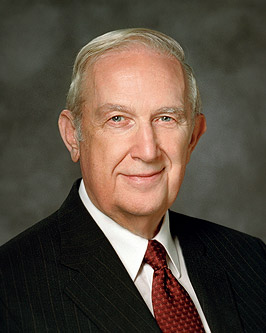
Let Us Be Men (D. Todd Christofferson of the Presidency of the Seventy, October 2006 General Conference)


We must arise from the dust of self-indulgence and be men! It is a wonderful aspiration for a boy to become a man—strong and capable; someone who can build and create things, run things; someone who makes a difference in the world. It is a wonderful aspiration for those of us who are older to make the vision of true manhood a reality in our lives and be models for those who look to us for an example.... In large measure, true manhood is defined in our relationship to women.... The Lord asked His disciples what manner of men they should be and then answered, “Verily I say unto you, even as I am”.


Years ago, when my brothers and I were boys, our mother had radical cancer surgery. She came very close to death. Much of the tissue in her neck and shoulder had to be removed, and for a long time it was very painful for her to use her right arm.

One morning about a year after the surgery, my father took Mother to an appliance store and asked the manager to show her how to use a machine he had for ironing clothes. The machine was called an Ironrite. It was operated from a chair by pressing pedals with one’s knees to lower a padded roller against a heated metal surface and turn the roller, feeding in shirts, pants, dresses, and other articles. You can see that this would make ironing (of which there was a great deal in our family of five boys) much easier, especially for a woman with limited use of her arm. Mother was shocked when Dad told the manager they would buy the machine and then paid cash for it. Despite my father’s good income as a veterinarian, Mother’s surgery and medications had left them in a difficult financial situation.

On the way home, my mother was upset: “How can we afford it? Where did the money come from? How will we get along now?” Finally Dad told her that he had gone without lunches for nearly a year to save enough money. “Now when you iron,” he said, “you won’t have to stop and go into the bedroom and cry until the pain in your arm stops.” She didn’t know he knew about that. I was not aware of my father’s sacrifice and act of love for my mother at the time, but now that I know, I say to myself, “There is a man.”

The prophet Lehi pled with his rebellious sons, saying, “Arise from the dust, my sons, and be men” (2 Nephi 1:21; emphasis added). By age, Laman and Lemuel were men, but in terms of character and spiritual maturity they were still as children. They murmured and complained if asked to do anything hard. They didn’t accept anyone’s authority to correct them. They didn’t value spiritual things. They easily resorted to violence, and they were good at playing the victim.

We see some of the same attitudes today. Some act as if a man’s highest goal should be his own pleasure. Permissive social mores have “let men off the hook” as it were, so that many think it acceptable to father children out of wedlock and to cohabit rather than marry. 1 Dodging commitments is considered smart, but sacrificing for the good of others, naive. For some, a life of work and achievement is optional. A psychologist studying the growing phenomenon of what he calls “young men stuck in neutral” describes this scenario:

“Justin goes off to college for a year or two, wastes thousands of dollars of his parents’ money, then gets bored and comes home to take up residence in his old room, the same bedroom where he lived when he was in high school. Now he’s working 16 hours a week at Kinko’s or part time at Starbucks.

“His parents are pulling their hair out. ‘Justin, you’re 26 years old. You’re not in school. You don’t have a career. You don’t even have a girlfriend. What’s the plan? When are you going to get a life?’

“‘What’s the problem?’ Justin asks. ‘I haven’t gotten arrested for anything, I haven’t asked you guys for money. Why can’t you just chill?’” 2

How’s that for ambition?

We who hold the priesthood of God cannot afford to drift. We have work to do (see Moroni 9:6). We must arise from the dust of self-indulgence and be men! It is a wonderful aspiration for a boy to become a man—strong and capable; someone who can build and create things, run things; someone who makes a difference in the world. It is a wonderful aspiration for those of us who are older to make the vision of true manhood a reality in our lives and be models for those who look to us for an example.

In large measure, true manhood is defined in our relationship to women. The First Presidency and Quorum of the Twelve Apostles have given us the ideal to pursue in these words:

“The family is ordained of God. Marriage between man and woman is essential to His eternal plan. Children are entitled to birth within the bonds of matrimony, and to be reared by a father and a mother who honor marital vows with complete fidelity. … By divine design, fathers are to preside over their families in love and righteousness and are responsible to provide the necessities of life and protection for their families.” 3

Over the years, I have visited members of the Church in many countries, and despite differences in circumstances and cultures, everywhere I have been impressed with the faith and capacity of our women, including some of the very young. So many of them possess a remarkable faith and goodness. They know the scriptures. They are poised and confident. I ask myself, Do we have men to match these women? Are our young men developing into worthy companions that such women can look up to and respect?

President Gordon B. Hinckley, speaking in this meeting in April 1998, gave specific counsel for young men:

“The girl you marry will take a terrible chance on you. … [You] will largely determine the remainder of her life. …

“Work for an education. Get all the training that you can. The world will largely pay you what it thinks you are worth. Paul did not mince words when he wrote to Timothy, ‘But if any provide not for his own, and specially for those of his own house, he hath denied the faith, and is worse than an infidel’ (1 Tim. 5:8).” 4

Integrity is fundamental to being men. Integrity means being truthful, but it also means accepting responsibility and honoring commitments and covenants. President N. Eldon Tanner, a former counselor in the First Presidency and a man of integrity, told of someone who sought his advice:

“A young man came to me not long ago and said, ‘I made an agreement with a man that requires me to make certain payments each year. I am in arrears, and I can’t make those payments, for if I do, it is going to cause me to lose my home. What shall I do?’

“I looked at him and said, ‘Keep your agreement.’

“‘Even if it costs me my home?’

“I said, ‘I am not talking about your home. I am talking about your agreement; and I think your wife would rather have a husband who would keep his word, meet his obligations, … and have to rent a home than to have a home with a husband who will not keep his covenants and his pledges.’” 5

Good men sometimes make mistakes. A man of integrity will honestly face and correct his mistakes, and that is an example we can respect. Sometimes men try but fail. Not all worthy objectives are realized despite one’s honest and best efforts. True manhood is not always measured by the fruits of one’s labors but by the labors themselves—by one’s striving. 6

Though he will make some sacrifices and deny himself some pleasures in the course of honoring his commitments, the true man leads a rewarding life. He gives much, but he receives more, and he lives content in the approval of his Heavenly Father. The life of true manhood is the good life.

Most importantly, when we consider the admonition to be men, we must think of Jesus Christ. When Pilate brought Jesus forth wearing a crown of thorns, he declared, “Behold the man!” (see John 19:4–5). Pilate may not have fully understood the significance of his own words, but the Lord indeed stood before the people then as He stands today—the highest ideal of manhood. Behold the man!

The Lord asked His disciples what manner of men they should be and then answered, “Verily I say unto you, even as I am” (3 Nephi 27:27; see also 3 Nephi 18:24). That is our ultimate quest. What did He do that we can emulate as men?

Jesus rejected temptation. When confronted by the great tempter himself, Jesus “[yielded] not to the temptation” (Mosiah 15:5). He countered with scripture: “Man shall not live by bread alone, but by every word that proceedeth out of the mouth of God” (Matthew 4:4). Gospel commandments and standards are our protection also, and like the Savior, we may draw strength from the scriptures to resist temptation.

The Savior was obedient. He forsook completely the “natural man” (Mosiah 3:19) and yielded His will to the Father (see Mosiah 15:7). He was baptized to show “that, according to the flesh he humbleth himself before the Father, and witnesseth unto the Father that he would be obedient unto him in keeping his commandments” (2 Nephi 31:7).

Jesus “went about doing good” (Acts 10:38). He employed the divine powers of the holy priesthood to bless those in need, “such as healing the sick, raising the dead, causing the lame to walk, the blind to receive their sight, and the deaf to hear, and curing all manner of diseases” (Mosiah 3:5). Jesus told His Apostles: “Whosoever of you will be the chiefest, shall be servant of all. For even the Son of man came not to be ministered unto, but to minister, and to give his life a ransom for many” (Mark 10:44–45). As His fellow servants, we may become great in His kingdom through love and service.

The Savior was fearless in opposing evil and error. “Jesus went into the temple of God, and cast out all them that sold and bought in the temple … and said unto them, It is written, My house shall be called the house of prayer; but ye have made it a den of thieves” (Matthew 21:12–13). He called upon all to repent (see Matthew 4:17) and be forgiven (see John 8:11; Alma 5:33). So might we stand firm in defending sacred things and in raising the warning voice.

He gave His life to redeem mankind. Surely we can accept responsibility for those He entrusts to our care.

Brethren, let us be men, even as He is. In the name of Jesus Christ, amen.

Notes:

 1. See, for example, James E. Faust, “Challenges Facing the Family,” Worldwide Leadership Training Meeting, Jan. 10, 2004, 1–2; Eduardo Porter and Michelle O’Donnell, “Middle-Aged, No Degree, No Wife,” New York Times, published in Atlanta Journal-Constitution, Aug. 6, 2006, p. A7; Peg Tyre, “The Trouble with Boys,” Newsweek, Jan. 30, 2006, 44–51.

 2. Leonard Sax, “Project Aims to Study Young Men Stuck in Neutral,” Washington Post, published in Deseret Morning News, Apr. 3, 2006, p. A13. “According to the Census Bureau, fully one-third of young men ages 22 to 34 [in the U.S.] are still living at home with their parents—a roughly 100 percent increase in the past 20 years.”

 3. “The Family: A Proclamation to the World,” Liahona, Oct. 2004, 49; Ensign, Nov. 1995, 102.

 4. “Living Worthy of the Girl You Will Someday Marry,” Ensign, May 1998, 49–50.

 5. In Conference Report, Oct. 1966, 99; or Improvement Era, Dec. 1966, 1137.

 6. In the late 1830s, after the Saints had abandoned Kirtland, the Lord called a man named Oliver Granger to go back and try to settle some unfinished matters for the First Presidency. In a revelation to the Prophet Joseph Smith, the Lord said: “Therefore, let [Oliver Granger] contend earnestly for the redemption of the First Presidency of my Church, saith the Lord; and when he falls he shall rise again, for his sacrifice shall be more sacred unto me than his increase, saith the Lord. … Therefore let no man despise my servant Oliver Granger, but let the blessings of my people be on him forever and ever” (D&C 117:13, 15; emphasis added).

Sunday, February 23, 2014

The Greatest Generation of Missionaries (M. Russell Ballard off the Quorum of the Twelve Apostles, October 2002 General Conference)

Source
What we need now is the greatest generation of missionaries in the history of the Church. We need worthy, qualified, spiritually energized missionaries.... We don’t need you to just fill a position; we need your whole heart and soul. We need vibrant, thinking, passionate missionaries who know how to listen to and respond to the whisperings of the Holy Spirit.... The bar that is the standard for missionary service is being raised.... [Parents], if we are “raising the bar” for your sons to serve as missionaries, that means we are also “raising the bar” for you.


In one of the most powerful and instructive stories from the Book of Mormon, the people of Ammon had covenanted never again to take up weapons for the shedding of blood. But “when they saw the danger, and the many afflictions … which the Nephites bore for them, they were moved with compassion and were desirous to take up arms in the defence of their country” (Alma 53:13). Helaman and his brethren persuaded them to honor their covenant with the Lord.

The scriptural account doesn’t tell us who first pointed out that their sons had not made the same covenant their parents had made. I like to think that it was one of the young men who suggested the possibility that he and his peers be allowed to “take up arms, and [call] themselves Nephites.

“And they entered into a covenant to fight for the liberty of the Nephites, yea, to protect the land unto the laying down of their lives” (Alma 53:16–17).

This was an extraordinary task for a group of 2,000 young men, but they were extraordinary young men. According to the scriptural record: “They were exceedingly valiant for courage, and also for strength and activity; but behold, this was not all—they were men who were true at all times in whatsoever thing they were entrusted.

“Yea, they were men of truth and soberness, for they had been taught to keep the commandments of God and to walk uprightly before him” (Alma 53:20–21).

The rest of the story tells how these young men fought valiantly against the much older and much more experienced Lamanite army. According to their leader, Helaman, “They … fought as if with the strength of God; … and with such mighty power did they fall upon the Lamanites, that they did frighten them; and for this cause did the Lamanites deliver themselves up as prisoners of war” (Alma 56:56).

Imagine that! These inexperienced young men were so spiritually and physically prepared, and so powerful, that they frightened their foes into surrendering! Although all 2,000 of the young men were wounded in battle at one time or another, not one was killed (see Alma 57:25). Again quoting Helaman, “And we do justly ascribe it to the miraculous power of God, because of their exceeding faith in that which they had been taught to believe—that there was a just God, and whosoever did not doubt, that they should be preserved by his marvelous power” (Alma 57:26).

Brethren, today we are fighting a battle that in many ways is more perilous, more fraught with danger than the battle between the Nephites and the Lamanites. Our enemy is cunning and resourceful. We fight against Lucifer, the father of all lies, the enemy of all that is good and right and holy. Truly we live in a time of which Paul prophesied, when “men shall be lovers of their own selves, covetous, boasters, proud, blasphemers, disobedient to parents, unthankful, unholy,

“Without natural affection, trucebreakers, false accusers, incontinent, fierce, despisers of those that are good,

“… lovers of pleasures more than lovers of God;

“Having a form of godliness, but denying the power thereof: from such turn away” (2 Tim. 3:2–5).

Does this sound familiar, brethren? To me it sounds like a night of prime-time television.

These are “perilous times.” We battle literally for the souls of men. The enemy is unforgiving and relentless. He is taking eternal prisoners at an alarming rate. And he shows no sign of letting up.

While we are profoundly grateful for the many members of the Church who are doing great things in the battle for truth and right, I must honestly tell you it still is not enough. We need much more help. And so, as the people of Ammon looked to their sons for reinforcement in the war against the Lamanites, we look to you, my young brethren of the Aaronic Priesthood. We need you. Like Helaman’s 2,000 stripling warriors, you also are the spirit sons of God, and you too can be endowed with power to build up and defend His kingdom. We need you to make sacred covenants, just as they did. We need you to be meticulously obedient and faithful, just as they were.

What we need now is the greatest generation of missionaries in the history of the Church. We need worthy, qualified, spiritually energized missionaries who, like Helaman’s 2,000 stripling warriors, are “exceedingly valiant for courage, and also for strength and activity” and who are “true at all times in whatsoever thing they [are] entrusted” (Alma 53:20).

Listen to those words, my young brethren: valiant, courage, strength, active, true. We don’t need spiritually weak and semicommitted young men. We don’t need you to just fill a position; we need your whole heart and soul. We need vibrant, thinking, passionate missionaries who know how to listen to and respond to the whisperings of the Holy Spirit. This isn’t a time for spiritual weaklings. We cannot send you on a mission to be reactivated, reformed, or to receive a testimony. We just don’t have time for that. We need you to be filled with “faith, hope, charity and love, with an eye single to the glory of God” (D&C 4:5).

As an Apostle of the Lord Jesus Christ, I call upon you to begin right now—tonight—to be fully and completely worthy. Resolve and commit to yourselves and to God that from this moment forward you will strive diligently to keep your hearts, hands, and minds pure and unsullied from any kind of moral transgression. Resolve to avoid pornography as you would avoid the most insidious disease, for that is precisely what it is. Resolve to completely abstain from tobacco, alcohol, and illegal drugs. Resolve to be honest. Resolve to be good citizens and to abide by the laws of the land in which you live. Resolve that from this night forward you will never defile your body or use language that is vulgar and unbecoming to a bearer of the priesthood.

And that is not all we expect of you, my young brethren. We expect you to have an understanding and a solid testimony of the restored gospel of Jesus Christ. We expect you to work hard. We expect you to be covenant makers and covenant keepers. We expect you to be missionaries to match our glorious message.

Now these are high standards. We understand that, but we do not apologize for them. They reflect the Lord’s standards for you to receive the Melchizedek Priesthood, to enter the temple, to serve as missionaries, and to be righteous husbands and fathers. There’s nothing new in them, nothing you haven’t heard before. But tonight we call upon you, our young brethren of the Aaronic Priesthood, to rise up, to measure up, and to be fully prepared to serve the Lord.

Many of you are already on this track, and we commend you for your worthiness and determination. For those of you who are not, let tonight be the beginning of your preparation process. If you find yourself wanting in worthiness, resolve to make the appropriate changes—beginning right now. If you think you need to talk to your father and your bishop about any sins you may have committed, don’t wait; do it now. They will help you to repent and change so you can take your place as a member of the greatest generation of missionaries.

Please understand this: the bar that is the standard for missionary service is being raised. The day of the “repent and go” missionary is over. You know what I’m talking about, don’t you, my young brothers? Some young men have the mistaken idea that they can be involved in sinful behavior and then repent when they’re 18 1/2 so they can go on their mission at 19. While it is true that you can repent of sins, you may or you may not qualify to serve. It is far better to keep yourselves clean and pure and valiant by doing such simple things as:

• Developing a meaningful prayer relationship with your Heavenly Father.
• Keeping the Sabbath day holy.
• Working and putting part of your earnings in a savings account.
• Paying a full and honest tithing.
• Limiting the amount of time spent playing computer games. How many kills you can make in a minute with a computer game will have zero effect on your capacity to be a good missionary.
• Giving the Lord more of your time by studying the scriptures and gaining an understanding of the marvelous message of the Restoration that we have for the world.
• Serving others and sharing your testimony with them.

Now, fathers, you have a vital role in this preparation process. We know that the most profound influence on helping young men prepare for the Melchizedek Priesthood, marriage, and fatherhood is the family. If your sons understand the basic doctrines required to become a faithful father, they will surely be ready to serve as a full-time missionary. Unfortunately, far too many fathers abdicate this eternal responsibility. You may assume that the bishop and the seminary, Sunday School, and Young Men teachers and leaders are in a better position to motivate and inspire your sons than you are. That simply is not the case. While ecclesiastical leaders are important to your son’s priesthood and missionary preparation, the Church exists as a resource to you. It is not a substitute for your inspired teaching, guidance, and correction.

Consequently, if we are “raising the bar” for your sons to serve as missionaries, that means we are also “raising the bar” for you. If we expect more of them, that means we expect more of you and your wife as well. Remember, Helaman’s 2,000 stripling warriors were faithful because “they had been taught to keep the commandments of God and to walk uprightly before him” (Alma 53:21)—and that instruction came in their homes.

Some fathers don’t think they have the right to ask worthiness questions of their children. They think that is the purview of the bishop alone. Fathers, not only do you have the right to know the worthiness of your children, you have the responsibility. It is your duty to know how your children are doing with regards to their spiritual well-being and progression. You need to monitor carefully the issues and concerns they share with you. Ask specific questions of your children regarding their worthiness, and refuse to settle for anything less than specific answers.

Too often our bishops have to instruct youth to talk to their parents about problems they are having. That procedure should actually flow the other direction. Parents should be so intimately aware of what is going on in their children’s lives that they know about the problems before the bishop does. They should be counseling with their children and going with them to their bishops if that becomes necessary for complete repentance. As divinely appointed judges in Israel, the bishop and the stake president determine worthiness and resolve concerns on behalf of the Church; but, fathers, you have an eternal responsibility for the spiritual welfare of your children. Please assume your rightful place as counselor, adviser, and priesthood leader in preparing your sons to bear the Melchizedek Priesthood and to serve as missionaries.

Now, a word to you bishops. I realize there are many young men who don’t have a faithful father in their home. In these cases, use the resources of the Church to see that these Aaronic Priesthood holders are taught by Melchizedek Priesthood brethren who can help them to prepare for their future priesthood service. Upon you bishops and you stake presidents rests the responsibility to recommend only those young men and women whom you judge to be spiritually, physically, mentally, and emotionally prepared to face today’s realities of missionary work. Brethren, judge wisely and remember: not every young man needs to be called to serve away from his home; some may best serve under your direction as ward missionaries.

To those of you who are currently serving as full-time missionaries, we thank you for your service. Tonight is a good time for each of you to take a close look at your performance; and if you are not measuring up, your mission president will help you make the necessary changes to be an effective, dedicated servant of the Lord Jesus Christ.

Finally, to those of you who have already served, please remember that you were released from your missions but not from the Church. You spent two years as a representative of the Lord Jesus Christ. We expect you to always look and act like one of His disciples. Look the part. Act the part. Don’t follow worldly trends and fashions. You are better than that. If you have slipped, then do what is necessary to regain your spiritual balance. The rules for happiness and success after your mission are pretty much the same as they were during your mission: pray hard, work hard, and be obedient. Get busy now and find your eternal companion to enjoy life with. Serve the Lord together, and raise up the next great generation.

My brethren, I have spoken plainly tonight. I hope you can feel the love and the concern that emanates from the First Presidency and the Quorum of the Twelve Apostles and other Church leaders as we ask you to prepare now to join us in taking the blessings of the restored gospel to all the people on the earth. Each one of you is precious, and we want you to be successful and secure in the battle for the souls of our Heavenly Father’s children. May God bless you with the courage to be “true at all times” (Alma 53:20) and with the vision to realize who you are and what the Lord has for you to do, I pray in the name of the Lord Jesus Christ, amen.

Dad, Are You Awake? (F. Melvin Hammond of the First Quorum of the Seventy, October 2002 General Conference)

Elder F. Melvin Hammond
Source
To every father, I pose the... question, “Dad, are you awake?” Do your sons ever wonder if you are asleep when it comes to the things that are most important to them? I would suggest that there are several areas that would indicate whether we are “awake” or “asleep” in the eyes of our sons.

A short while ago, Elder Pace, Elder Condie, and I met with the First Presidency. As we entered the room, President Hinckley looked carefully at us and then with a smile on his face said, “How can three white-headed, old men be the Young Men presidency of this Church?” Our only response was, “Because you called us to be, President.”

Young men, we hope that you are excited about the Aaronic Priesthood: Fulfilling Our Duty to God program. It has been introduced to all of the Aaronic Priesthood throughout the world. It is designed to bless you spiritually, physically, socially, and mentally. The requirements are meaningful and will stretch you almost to the limits of your capability. You will be able to establish personal goals and achieve them with the help of your parents and your great leaders. There is a wonderful excitement associated with this program all over the Church. We want every one of you to qualify and receive the coveted Duty to God Award.

Many years ago I took our only son on his first camping, fishing trip. He was just a boy. The canyon was steep, and the descent was difficult. But the fishing was good. Every time I hooked a fish I would give the pole to the eager boy, and with shouts of joy he would reel in a beautiful trout. In the shadows and coolness of the late afternoon, we began our climb back up to the rim high above us. He scrambled rapidly up the mountain ahead of me with a challenging, “Come on, Dad. I’ll bet I can beat you to the top.” The challenge was heard but wisely ignored. His small frame seemed literally to fly over, under, and around every obstacle, and when every step that I took seemed ridiculously like my last, he had reached the top and stood cheering me on. After supper we knelt in prayer. His small voice rose sweetly heavenward in benediction to our day. Then we climbed into our large double sleeping bag, and after a bit of pushing and pulling I felt his little body snuggle and settle tightly against mine for warmth and security against the night. As I looked at my son beside me, suddenly I felt a surge of love pass through my body with such force that it pushed tears to my eyes. And, at that precise moment, he put his little arms around me and said, “Dad.”

“Yes, son.”

“Are you awake?”

“Yes, my son, I am awake.”

“Dad, I love you a million, trillion times!”

And immediately he was asleep. But I was awake far into the night, expressing my great thanks for such wonderful blessings clothed with a little boy’s body.

Now my son is a man with a son of his own. Once in a while the three of us go fishing. I look at my little red-headed grandson beside his father, and I see in my mind’s eye the image of that wonderful moment long ago. The question so innocently asked, “Dad, are you awake?” still rings in my heart.

To every father, I pose the same penetrating question, “Dad, are you awake?” Do your sons ever wonder if you are asleep when it comes to the things that are most important to them? I would suggest that there are several areas that would indicate whether we are “awake” or “asleep” in the eyes of our sons.

First, our love for God and accepting our role as the family leader in keeping His commandments. Some years ago, following a stake conference, I felt impressed to pay a visit to a priesthood brother who had fallen away from the Church. We found him working in his garden. I approached him and said, “Dear brother, the Lord Jesus Christ has sent me to see you. I am Elder Hammond, one of His servants.”

We exchanged a Latin abrazo and entered into his lovely little home. He called for his wife and three children to join us. Two handsome young men and a beautiful girl sat beside their father and mother. I asked the children what they would like, more than anything else in the world, right now. The oldest son spoke: “If only all of us could go back to church as a family, we would be so happy—so grateful.” We told them how much they were needed by the Savior and how He loved them. We bore our testimonies to them and then knelt in prayer. The father prayed. The mother wept. They are now back in full fellowship. The children are proud of their father, and they are happy.

Every father in the Church should function as the patriarch of his home. He should take the lead in spiritually guiding the family. He ought not to delegate nor abrogate his responsibilities to the mother. He should call for family prayer, family home evening, scripture reading, and occasional father interviews. He is the protector, the defender, and the kindly source of discipline. It is the father who should lead, unify, and solidify the family unit by accepting the priesthood of God and responding to the calls and privileges associated with priesthood authority. His relationship with God and His Son, Jesus Christ, is one of the beacons which will lead his sons and daughters through the stormy shoals of life.

If Dad is a true disciple of Jesus Christ, then the sons will follow him as the night the day. “Dad, are you awake?”

Second, the relationship we have with our wives—their mothers. Considering everything else that we do, the way we treat our wives could well have the greatest impact on the character of our sons. If a father is guilty of inflicting verbal or physical abuse in any degree on his companion, his sons will resent him for it, perhaps even despise him for it. But interestingly enough, when they are grown and marry, they are likely to follow the same pattern of abuse with their wives. There is an urgent need in our society for fathers who respect their wives and treat them with sweet, tender love.

Recently I heard of a father who foolishly called his beautiful, intelligent wife “stupid” and “dumb” in a most degrading manner for some small mistake that she had innocently made. The children listened, embarrassed and frightened for their mother. She was belittled in front of those that she loved most. Although an apology and forgiveness were expressed, there still remained the hurt and shame of a senseless moment.

The Spirit of the Lord cannot be expected to bless our lives if we persist in being angry, callous, and cruel to our mates. We cannot expect our sons to develop respect and gentleness toward their mothers if we do not provide the proper example. President David O. McKay said, “The most important thing a father can do for his children is to love their mother” (quoted from Theodore Hesburgh, Reader’s Digest, Jan. 1963, 25; in Richard Evans’ Quote Book [1971], 11). “Dad, are you awake?”

Third, to provide discipline that is just and administered with love. Too often out of our own frustration and weakness we raise our hands to strike our children, usually in an attempt to protect our own selfish pride. Every child needs to be disciplined. Not only do they need it; they expect it; they want it. Discipline gives direction and teaches self-control, but in all discipline there should be a sense of righteous judgment and pure love.

When I was a little boy, my widowed mother gave me the most severe discipline possible. She said, with tears in her eyes, “My son, I am so disappointed in you.” The pain in my heart was more than I could bear. A thousand lashes could not have cut me so deeply. I knew that such a rebuke could only have been made to me out of her pure love, for if there was one thing that I was certain of, it was that my mother loved me. I resolved never again to be subject to the disappointment and the broken heart of an angel mother. I believe that I have succeeded in that resolve.

When it comes to discipline, “Dad, are you awake?”

Dads, it is imperative that the challenges I have mentioned be mastered in our lives if our sons are to be spiritually and emotionally mature. If we do, then they will not be ashamed of us, nor will they ever be ashamed of themselves. They will become men of honor, respect, full of love, willing to serve the Savior and submit their will to Him. Then we will rejoice in the fact that they are ours forever. They will say, “Dad, are you awake?”

And we will respond, “Yes, my son, I am awake.”

In the name of Jesus Christ, amen.